
Alternative Fuels
the move to alternative fuels
Despite its critical role in public transport, moving millions of commuters daily across urban, peri-urban and rural areas, the minibus taxi industry remains heavily dependent on conventional fossil fuels, mainly petrol and diesel. This dependence exposes taxi operators to volatile fuel prices and contributes to growing environmental pressures. As governments, industries and transport operators search for more sustainable and cost-efficient mobility solutions, exploring alternative fuel options has become an important consideration for the future of the minibus taxi industry.
Alternative fuels are energy sources that can replace or reduce the use of traditional petroleum-based fuels. In the transport sector, these include options such as liquefied petroleum gas (LPG), compressed natural gas (CNG), biofuels, electricity used in battery-electric vehicles, and hybrid systems that combine conventional engines with electric power. The suitability of these options for the taxi industry depends on practical factors such as vehicle compatibility, refuelling infrastructure, upfront conversion or acquisition costs, and the reliability of fuel supply.
Because minibus taxis operate on high-frequency routes and travel long distances each day, any alternative fuel solution must support quick refuelling or charging, maintain vehicle performance, and avoid disruptions to daily operations. At the same time, the economic viability of the fuel option remains critical for owner-operators whose businesses rely on predictable operating costs. As technology advances and supporting infrastructure improves, alternative fuels present an opportunity to improve fuel efficiency, reduce emissions and strengthen the long-term sustainability of the minibus taxi industry.
Liquified Petroleum Gas (LPG) as a viable alternative fuel
Liquefied Petroleum Gas (LPG) presents a practical alternative that addresses both the economic and environmental challenges associated with conventional fuels. Vehicles can be converted to operate on LPG while retaining the ability to run on petrol, allowing operators to switch between fuels, when necessary, without major mechanical modifications. This dual-fuel capability provides operational flexibility while reducing reliance on petrol. The lower cost of LPG, which can offer savings of up to 30% compared with petrol, allows taxi operators to recover the cost of vehicle conversion within a relatively short period.


Converting your minibus to LPG
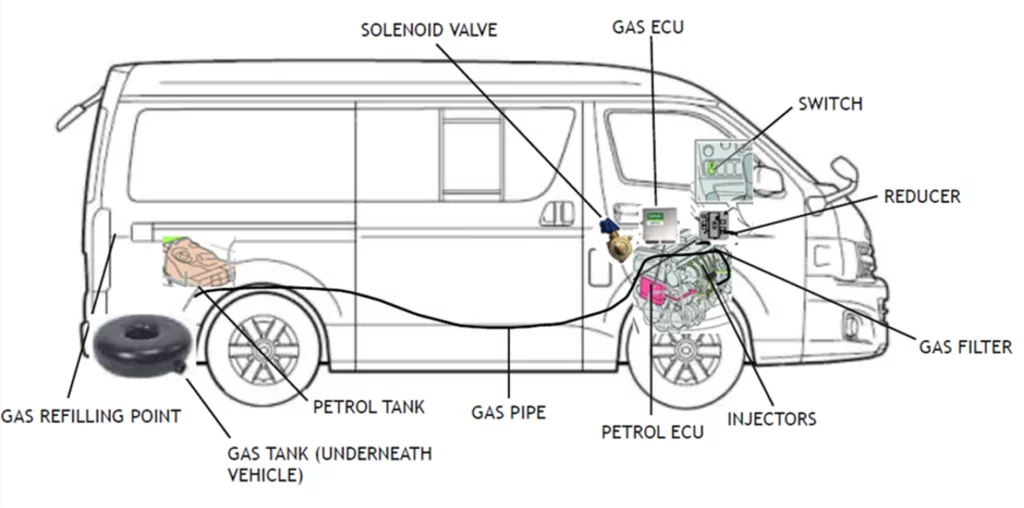
Converting a minibus taxi into a LPG system by retro fitting it with the conversion kit also allows the vehicle to act as a dual fuel system, that means it continues to retain its old fuel injection system plus the new LPG system. Thereby giving the minibus more options to choose from when it is traveling in an area with few or no LPG refilling centres.
In converted minibus taxis, there is, both the older Petrol mechanism and the built-on LPG systems. In order to switch between the two systems, TRSA will also install a switch on the dashboard that will allow you to choose which fuel to use.
A 4-cylinder LPG conversion kit typically includes everything needed to convert a petrol (gasoline) vehicle to run on liquefied petroleum gas (LPG). Below is a breakdown of the standard components included in a complete LPG 4-cylinder kit, including the tank:
Installation Requirements
To ensure the safe, reliable and compliant conversion of minibus taxis to LPG fuel systems, all installations must meet specific technical and legal requirements as outlined by TRSA. These requirements are designed to protect the safety of commuters and drivers, maintain vehicle performance, and ensure alignment with national standards and regulatory frameworks.
Compatibility of LPG Conversion Kit
- The LPG conversion kit must be suitably matched to the make, model and engine specifications of the minibus taxi.
- Using an incompatible kit may compromise vehicle performance, increase fuel consumption, or lead to mechanical issues. For this reason, only TRSA approved kits that have been thoroughly tested and certified for use in minibus taxis may be installed.
Professional Installation by Certified Installer
- All conversions are conducted by a TRSA Certified installer. The technicians are specially trained and certified to perform LPG system installations in accordance with strict safety and quality standards.
- This ensures not only the integrity and safety of the fuel system but also compliance with all applicable legal and regulatory requirement
Filling Stations
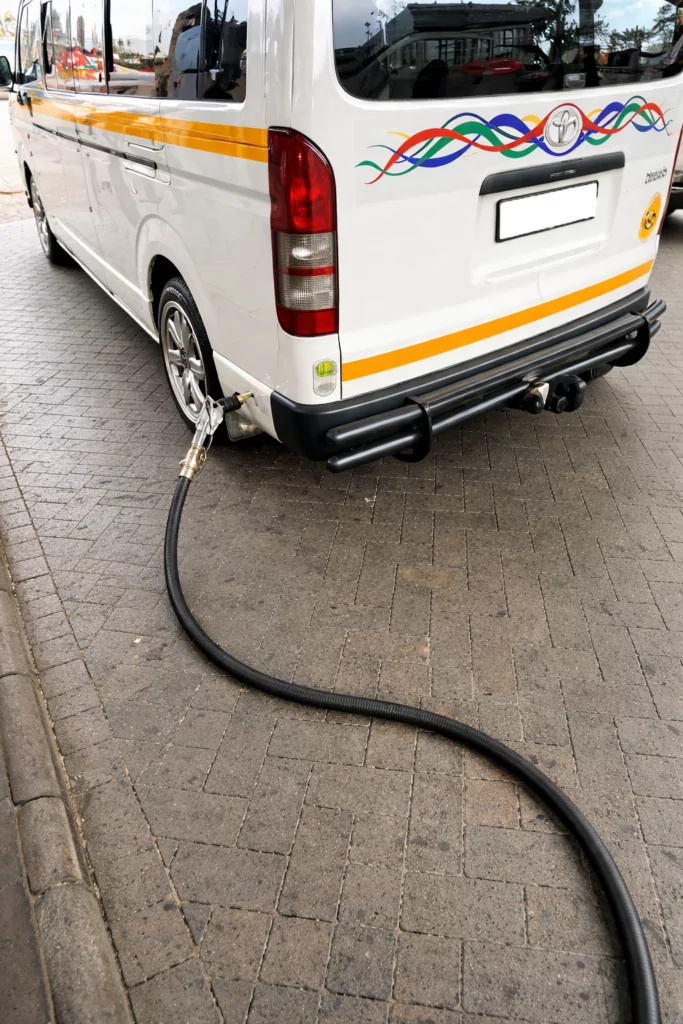
LPG filling stations are a critical part of enabling the use of LPG as an alternative fuel in the minibus taxi industry. These stations are typically designed to allow for quick and safe refuelling, similar to conventional petrol stations, which is essential for taxis operating on tight schedules and high-frequency routes. The availability and location of LPG stations, particularly along key taxi routes and near ranks, directly influence the practicality of adopting LPG, as operators need reliable and convenient access to fuel throughout the day.
Performance and Engine Benefits
Liquefied Petroleum Gas (LPG) offers several performance advantages that make it an attractive alternative fuel for vehicles. One of its key characteristics is its higher-octane rating compared with petrol, which reduces engine knocking and allows for smoother, more controlled combustion. This resistance to pre-ignition minimises internal engine stress, enhancing durability and reducing wear and tear. Studies have shown that engines running on LPG can last up to twice as long as those running solely on petrol.
LPG combustion also results in minimal carbon buildup within the engine, which delivers several practical maintenance benefits: longer-lasting spark plugs, less frequent oil changes, and reduced internal engine corrosion. These advantages translate to improved reliability and lower long-term maintenance costs for operators.
Environmental and Operational Advantages of LPG
When compared to petrol and diesel, LPG offers several advantages:

Environmental Impact
LPG produces significantly cleaner emissions, including lower levels of carbon monoxide (CO), nitrogen oxides (NOₓ) sulphur oxides (SOₓ), and particulates, all of which contribute to air pollution. Being composed of simple hydrocarbons, LPG is lead-free and additive-free and unlike liquid fuels, it poses no risk of soil or water contamination, as it vaporises if released into the atmosphere.
Engine Efficiency and Maintenance
LPG engines are nearly as efficient as petrol engines, and while diesel remains the most fuel-efficient option, LPG strikes a strong balance between performance, maintenance and cost. Clean combustion ensures that engine oil stays uncontaminated for longer, reducing servicing requirements. Moreover, because LPG is gaseous, it does not wash away lubricants from cylinder walls, lowering wear and extending engine life.

Safety
LPG 9 000L above ground refueling storage tanks are engineered to be stronger than petrol tanks and are subject to rigorous safety standards. In the event of a leak, LPG disperses quickly into the atmosphere rather than pooling on the ground, reducing the risk of fire or environmental contamination. Modern LPG systems also incorporate multiple safety mechanisms, including pressure relief valves and automatic shut-off features.
